
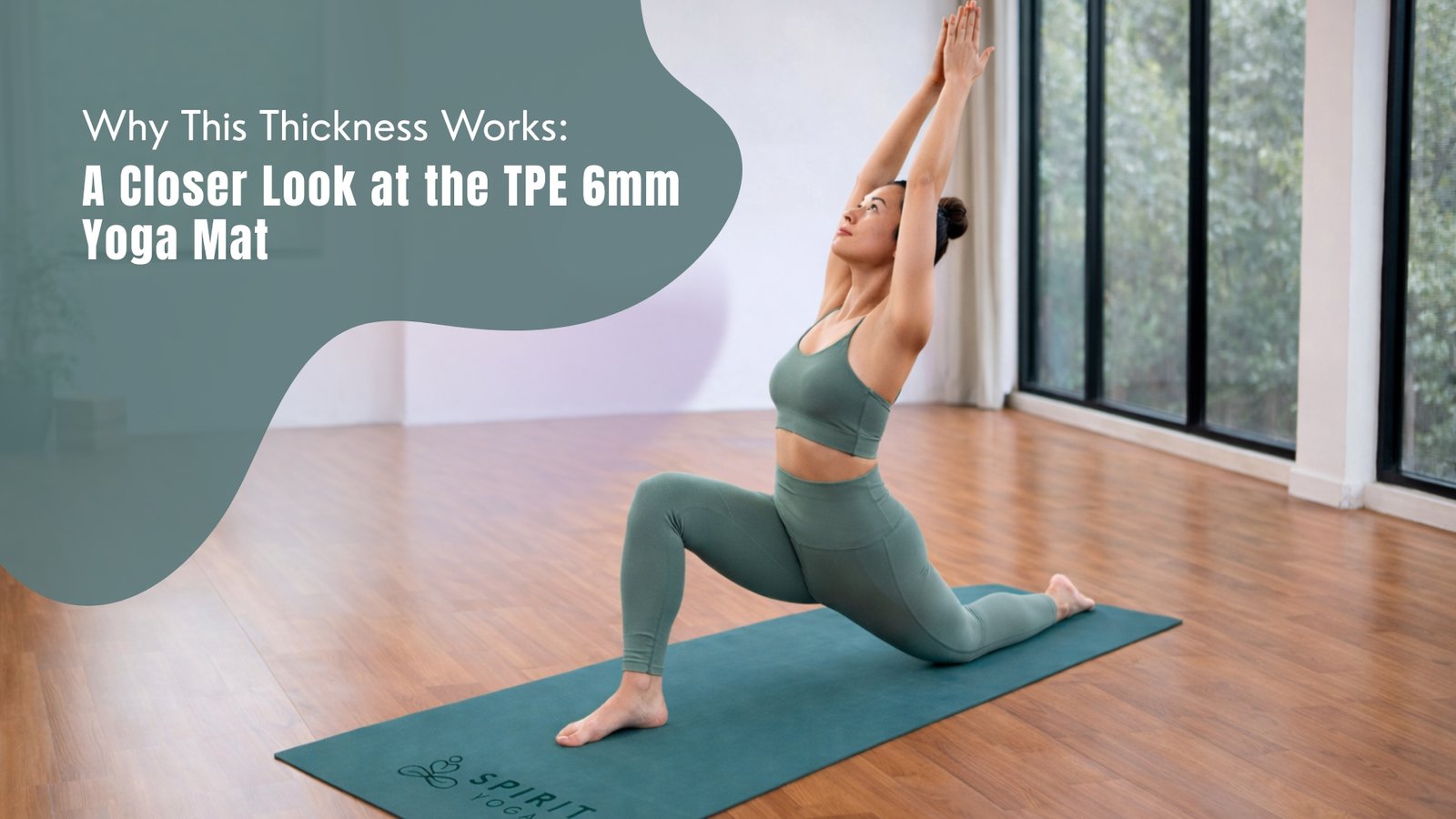
The issue of thickness is usually considered a technicality when selecting a yoga mat. It is something very personal to anyone who is a regular. You can feel it as soon as your knees are on the mat in low lunge, or your spine is rolling in savasana. Too thin, it is unforgiving on the floor. Too heavy, and moderation begins to die.
Here the TPE 6mm yoga mat can be noticed silently.
It doesn’t try to be extreme. It provides a sensible compromise instead, friendly without being heavy, comfortable without being wobbly. In this blog we go a step further to understand why 6mm thickness is so good and this is particularly with the TPE material since it is eco-friendly and it is also in the support of physical alignment and mindfulness.
Yoga has to do with connectedness- of breath, body, and ground. The surface where such connection occurs is the mat. Thickness directly affects:
An excessively thin mat can put strain on wrists, knees and hips. An excessively thick mat will cause standing poses to feel unsteady and unconnected with the earth.
The 6mm thickness is in the balance zone and therefore it can be applied in an extensive practice and practitioner.
TPE (Thermoplastic Elastomer) is a new environmentally friendly treatment material that is flexible and strong. It provides a very special balancing act when combined with a 6mm thickness.
The TPE yoga mat is also lighter, softer, and more movement sensitive than the classic PVC mats. It squeezes only as much as it can take and it springs, providing you with support without sinking.
The actual power of a 6mm yoga mat is the ability to provide the body with the support in both motion and motionlessness.
Firmness underfoot is necessary in poses such as Warrior II, Chair Pose or Plank. Its thickness of 6mm does not allow extreme compression to take place and therefore you may ground down and keep yourself in balance.
The additional cushioning helps to cushion the pressure points in seated twists, hip opener, or kneeling asanas, particularly, the knees, ankles and tailbone.
This is a two-fold advantage that makes the TPE 6mm yoga mat appropriate in the mixed practices that involve flow, holds, and relaxation.
|
Thickness |
Comfort Level | Stability | Best For |
|
3–4mm |
Low to Medium | High | Travel, advanced balance-focused practice |
| 6mm | Medium to High | Balanced |
Daily practice, mixed yoga styles |
| 8–10mm | Very High | Low to Medium |
Gentle yoga, therapy, joint sensitivity |
This table highlights why 6mm thickness is often considered the most versatile option.
A TPE 6mm yoga mat adapts well across different styles of yoga:
Instead of changing mats for different styles, many practitioners find that 6mm becomes their one-mat solution.
One of the most common complaints among yoga practitioners is knee and wrist discomfort. While thicker mats solve this problem, they often introduce instability.
A 6mm TPE yoga mat absorbs impact selectively. It softens pressure where needed while keeping you connected to the floor. This makes it ideal for:
The mat supports the body without isolating it from the earth beneath.
Another reason this thickness works so well is practicality. A TPE 6mm yoga mat remains lightweight and easy to roll, making it ideal for:
Unlike very thick mats, it doesn’t feel bulky or heavy, which encourages consistency in practice.
|
Feature |
TPE 6mm Yoga Mat | PVC Yoga Mat | Rubber Yoga Mat |
|
Eco-friendly |
Yes | No | Medium |
|
Weight |
Lightweight | Heavy | Heavy |
| Cushioning | Balanced | Firm |
Dense |
| Grip Feel | Soft, natural | Sticky |
Strong, intense |
| Odor | Minimal | Chemical smell |
Natural rubber scent |
This comparison shows why TPE 6mm yoga mats are increasingly preferred by mindful practitioners.
Yoga is not only about movement. During savasana or seated meditation, the mat becomes a resting place. A 6mm thickness provides just enough softness to let the body relax without feeling swallowed by the surface.
The mat supports:
This subtle comfort helps you stay present, rather than distracted by physical discomfort.
This thickness is ideal if you:
Whether you’re new to yoga or deep into your journey, 6mm offers reliability without excess.
The TPE 6mm yoga mat does not make any attempt to be extreme. Rather it helps sustain the silent regularity that yoga demands–day by day, breath by breath.
Even in a profession where consciousness is more important than wastage, 6mm profundity merely functions- of course intelligently, and dependably.
Copyright © 2025. Myspirityoga.com. All Rights Reserved
WhatsApp us