
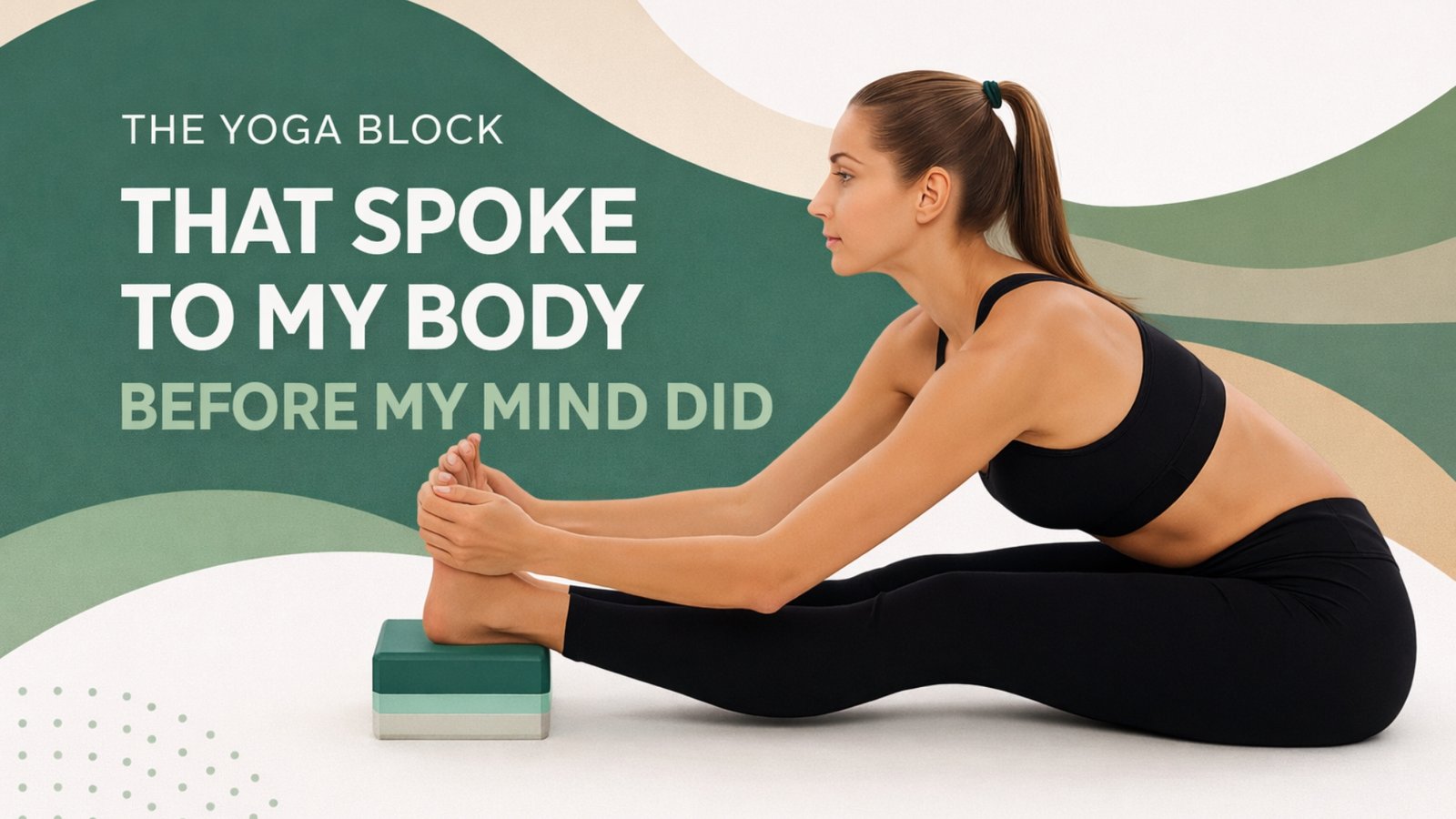
For years, I believed my yoga practice lived in my head.
I memorized pose names, corrected angles, watched alignment videos, and counted breaths like milestones. I thought progress meant going deeper, holding longer, and looking more “advanced.” My mat became a place of effort, not ease. And my body—quiet, patient—waited for me to notice it.
It took something very simple to change that relationship.
Not a retreat.
Not a breakthrough pose.
Just a yoga block.
In the beginning, my body spoke softly. A tight hamstring here. A stiff lower back there. Slight discomfort in my hips that I brushed aside. I told myself it was part of the process. Yoga, after all, was supposed to challenge you.
But over time, those whispers became resistance. My breath shortened in poses that were meant to feel grounding. My shoulders tightened where they should have softened. I stayed in my head, trying to “do yoga right,” while my body quietly opted out.
I didn’t realize it then, but I wasn’t practicing yoga—I was performing it.
One ordinary morning, during a familiar sequence, I paused in a standing forward fold. My hands hovered inches above the mat. Normally, I would have pushed—rounded my spine, forced the reach, ignored the sensation in my back.
Instead, I placed a yoga block beneath my hands.
Nothing dramatic happened.
But everything changed.
My spine lengthened without effort. My breath moved freely. My legs stopped gripping. For the first time, my body didn’t feel like something I had to manage.
It felt like something I could trust.
What surprised me most was not the physical relief—it was the emotional one. Using the yoga block felt like permission. Permission to stop striving. Permission to acknowledge where my body was that day, not where my ego wanted it to be.
The block didn’t push me deeper into the pose.
It allowed me to stay.
That’s when I realized something essential:
Yoga isn’t about going further. It’s about listening better.
Before, my practice sounded like commands:
With the yoga block, the language softened:
The block didn’t correct my body. It met it. And in that meeting, my body responded with ease instead of resistance.
|
Aspect of Practice |
Without Yoga Block | With Yoga Block |
|
Breath |
Shallow or controlled | Natural and steady |
|
Muscle engagement |
Excess tension | Balanced effort |
| Joints | Compressed or strained |
Supported and aligned |
| Mental state | Distracted, goal-focused |
Calm, present |
| Pose duration | Forced holding |
Comfortable stillness |
This wasn’t about making poses easier.
It was about making them truer.
I used to believe depth meant success. Deeper stretch, deeper pose, deeper bend. But the yoga block taught me that depth without awareness is just strain in disguise.
In hip openers, the block supported my pelvis so my lower back could relax. In seated poses, it elevated my hips just enough for my spine to find its natural curve. In balance poses, it gave my hand a place to rest so my nervous system could calm down.
Each time, the lesson was the same:
When the body feels safe, it opens on its own.
Once I started practicing with a yoga block regularly, I noticed something subtle but profound. My body began to lead.
I no longer needed to think about alignment as much. My breath guided my movement. My limits became clearer—not as obstacles, but as information.
The block didn’t teach my body anything new.
It reminded my mind to stop interrupting.
Not every yoga block feels the same. Over time, I became aware of qualities that allowed a block to truly support rather than distract.
|
Quality |
How It Supports the Practice |
|
Stability |
Builds trust in weight-bearing poses |
|
Comfortable surface |
Allows relaxation instead of gripping |
| Proper height |
Meets the body where it is |
| Non-slip feel |
Encourages stillness and confidence |
| Balanced firmness |
Supports without pushing back |
When these qualities are present, the block disappears into the practice. It stops feeling like a prop and starts feeling like a quiet companion.
The biggest change the yoga block brought wasn’t physical—it was mental. I stopped measuring my practice by what it looked like. I started measuring it by how it felt afterward.
Did I feel calmer?
More grounded?
More connected to my breath?
If the answer was yes, the practice was enough.
There’s a misconception that using support makes yoga less intense or less meaningful. My experience has been the opposite. With the yoga block, my practice became deeper—not in shape, but in sensation.
I could stay longer in poses without fatigue. I noticed subtle shifts in my body that I had missed before. I became more patient, not just on the mat but off it too.
The block taught me that softness is not weakness.
It’s intelligence.
Perhaps the most unexpected change was emotional. When I stopped forcing my body, it stopped resisting me. There was less frustration, less comparison, less self-judgment.
Yoga became less about fixing myself and more about understanding myself.
And that understanding didn’t come from effort.
It came from support.
If I could speak to the version of myself who thought yoga was about pushing harder, I would say this:
You don’t need to earn your practice.
You don’t need to prove flexibility.
You don’t need to ignore discomfort to grow.
Sometimes, the most powerful thing you can do is place a block beneath your hands and listen.
The yoga block never gave instructions.
It never corrected me.
It never demanded anything.
It simply showed up—steady, quiet, reliable—and let my body speak.
And once I learned how to listen, everything else followed.
Copyright © 2025. Myspirityoga.com. All Rights Reserved
WhatsApp us